

Choosing the right habitat is one of the most important parts of bringing home a new pet. Food matters. Handling matters. Enrichment matters. Veterinary care matters. But the habitat is the foundation everything else sits on.
A good habitat helps an animal feel safe, stay healthy, move naturally, rest properly, and behave like itself. A poor habitat can create stress, illness, frustration, poor appetite, aggression, escape attempts, and long-term health problems.
The tricky part is that “habitat” does not mean the same thing for every pet. A fish needs stable water. A snake needs secure hides and proper temperature zones. A bearded dragon needs heat, UVB, and room to move. A guinea pig needs space, shelter, bedding, and places to explore. A rabbit needs far more than a small hutch.
The best habitat is not the one that looks nicest to us. It is the one that works best for the animal living in it.
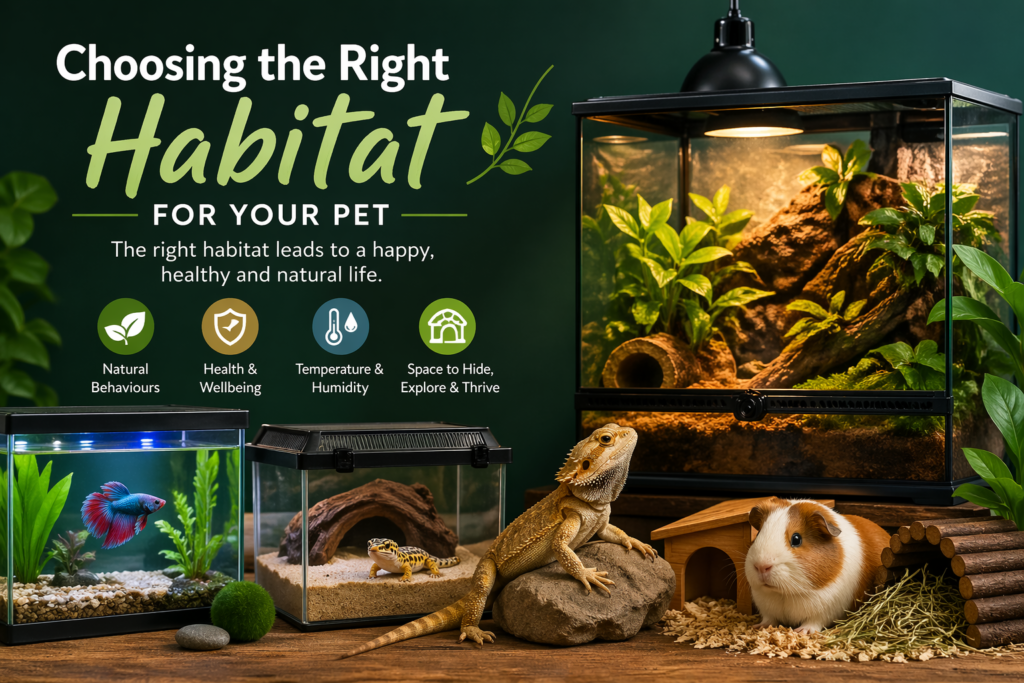
Start With the Species, Not the Setup
One of the biggest mistakes new pet owners make is buying the enclosure first and choosing the animal second.
It is easy to fall in love with a cute tank, cage, or terrarium. The problem is that the enclosure may not match the animal’s adult size, activity level, temperature needs, humidity needs, social needs, or natural behaviour.
Before buying the habitat, ask:
- What species is this animal?
- How large will it be as an adult?
- Is it active, shy, territorial, social, aquatic, arboreal, burrowing, or ground-dwelling?
- Does it need heat, UVB, humidity control, filtration, or special lighting?
- Does it need to live alone, in pairs, or in a group?
- How much space does it need to move normally?
- What does it need for hiding, resting, feeding, and enrichment?
The right habitat starts with the animal’s natural needs. The enclosure should be chosen around those needs, not around what happens to fit on a shelf.
Bigger Is Usually Better
Small habitats are often sold as beginner-friendly, but they are not always easier to manage.
For fish, larger aquariums are usually more stable because water temperature and chemistry do not swing as quickly. The RSPCA notes that larger volumes of water help provide more stable temperatures and water conditions for aquarium fish. (Merck Veterinary Manual)
For rabbits and guinea pigs, space is just as important. These animals need room to move, stretch, hide, rest, eat, and explore. The RSPCA recommends that two medium-sized rabbits have a living space no smaller than 3 metres by 2 metres and 1 metre high, including their shelter and exercise area. (RSPCA)
For reptiles, enclosure size depends heavily on species and adult size. A young reptile may look tiny in a starter tank, but many species grow quickly. The habitat needs to support the animal it will become, not just the animal you bring home.
A habitat should never be viewed as just a container. It is the animal’s home, exercise area, shelter, climate system, feeding station, and safety zone.
Fish Need Stable Water, Not Just a Pretty Tank
Aquariums are beautiful, but they are also life-support systems.
Clear water does not automatically mean safe water. Fish live directly in their environment. They breathe through it, absorb changes through it, and are affected very quickly when water quality shifts.
A good fish habitat needs:
- Proper tank size
- Filtration
- Dechlorinated water
- Stable temperature
- Appropriate pH and water chemistry
- Safe decorations
- Hiding places
- Swimming space
- Regular testing
- A proper cycling period before stocking
Merck Veterinary Manual identifies poor water quality as the most common cause of environmental-related disease in fish and recommends routine monitoring for chlorine, pH, temperature, and salinity where applicable. (Merck Veterinary Manual)
For new fish owners, this means the habitat is not ready just because the tank is full and the filter is running. The aquarium needs time to establish beneficial bacteria, and the water needs to be tested before fish are added.
A good aquarium is built slowly. The fish will do better, and the owner will have fewer problems.
Reptiles Need Choice
Reptile habitats are all about controlled choice.
Most reptiles are ectothermic, which means they rely on their environment to help regulate body temperature. They cannot warm and cool themselves the same way mammals do. The American Veterinary Medical Association notes that reptiles generally need to be housed in an environment with a specific temperature range known to be appropriate for that species. (AVMA)
This is why reptile enclosures need gradients.
A good reptile habitat may include:
- A warm side
- A cool side
- A basking area
- Hides on more than one side of the enclosure
- UVB lighting where required
- Proper humidity
- Safe substrate
- Climbing, digging, or burrowing opportunities where species-appropriate
- Secure doors or lids
- Thermometers and hygrometers
- A thermostat-controlled heat source
A reptile should be able to move between warmer and cooler areas, brighter and shaded areas, open and hidden areas, and dry or humid zones where appropriate. The RSPCA describes this kind of light-to-shade arrangement for leopard geckos as a photogradient, with lighting and heat grouped so the animal can choose between brighter warmth and more shaded cooler areas. (RSPCA)
The key word is choice. A reptile forced into one fixed condition all day has fewer ways to regulate itself.
Small Mammals Need More Than a Cage
Rabbits, guinea pigs, hamsters, gerbils, rats, and mice all need habitats that allow natural behaviours.
That means space to move, places to hide, safe bedding, chewing opportunities, nesting material where appropriate, enrichment, and protection from drafts, overheating, predators, and rough handling.
Guinea pigs, for example, need enough space to play, hide, move freely, stretch out, explore, rest, and access food, water, bedding, and enrichment. (RSPCA Knowledgebase)
A good small mammal habitat should include:
- Proper floor space
- Safe bedding
- Hides or shelters
- Chew-safe enrichment
- Clean water
- Appropriate food areas
- Safe exercise space
- Good ventilation
- Protection from extreme heat or cold
- Social housing where species-appropriate
Small does not mean simple. Many small mammals are intelligent, active, and sensitive to their environment. A bare cage may keep an animal contained, but it does not necessarily give that animal a good life.
“The environment animals live in should activate their positive emotions as much as possible.”
“Animals Make Us Human.”
–Temple Grandin
Grandin is a Professor of Animal Science at Colorado State University with a long career in animal behaviour, welfare, and facility design.
Hides Are Not Optional
Almost every prey species needs somewhere to hide.
Hiding is not a bad habit. It is not anti-social. It is not something to “train out” of an animal. Hiding is a normal safety behaviour.
A good habitat should include secure retreats that match the species. That may mean caves for reptiles, plants and structure for fish, tunnels for small mammals, covered shelters for rabbits, or dense planting and decor for shy aquarium species.
Without proper hiding places, animals may become stressed, defensive, inactive, or unwilling to eat. With good hiding places, many animals actually become more confident because they know they have somewhere safe to retreat.
Security often creates visibility. An animal that feels safe is more likely to behave naturally.
Temperature and Humidity Matter
Temperature and humidity are not small details. For many pets, they are core health requirements.
This is especially true for reptiles, amphibians, fish, and some small mammals. Incorrect temperature or humidity can affect digestion, shedding, appetite, immune function, respiration, activity level, and overall welfare.
For reptiles, VCA Canada notes that improper temperature and humidity gradients are among the most common contributing factors to health problems in captive reptiles. (VcaCanada)
For fish, temperature also matters because different species have different requirements. Merck Veterinary Manual notes that tropical fish often need water near 25°C, while species from more temperate areas do better at lower temperatures. (MSD Veterinary Manual)
Do not guess. Use proper measuring equipment:
- Thermometer
- Hygrometer
- Thermostat for heat sources
- Aquarium test kit
- Water temperature monitor
- UVB guidance based on species and lamp distance
The habitat should be measured, not estimated.
Enrichment Should Match Natural Behaviour
Enrichment does not mean cluttering the habitat with random decorations. It means giving the animal appropriate ways to express normal behaviour.
For fish, that may mean plants, caves, current, open swimming space, sand, wood, or rockwork.
For reptiles, it may mean climbing branches, digging substrate, hides, basking shelves, textured surfaces, or feeding enrichment.
For rabbits and guinea pigs, it may mean tunnels, hides, chew items, hay, platforms where safe, foraging activities, and supervised exercise space.
The best enrichment is species-specific. A habitat should answer the question:
What would this animal naturally try to do if given the chance?
Then the setup should support those behaviours safely.
Think About Cleaning Before You Build It
A habitat has to be healthy for the animal and manageable for the owner.
If the enclosure is difficult to clean, maintenance will get skipped. If maintenance gets skipped, the animal pays for it.
Before setting up the habitat, think through:
- How will waste be removed?
- How often does bedding need changing?
- Can water bowls be cleaned easily?
- Can filters be serviced without crashing the system?
- Can hides and decor be removed safely?
- Is the substrate appropriate and sanitary?
- Is there good ventilation?
- Can the animal be safely secured during cleaning?
Clean does not always mean sterile. For aquariums and reptile enclosures, over-cleaning can also disrupt beneficial biological systems. The goal is steady, appropriate maintenance, not panic-cleaning once things look bad.
Avoid Impulse Habitats
Pet stores are full of starter kits. Some are useful. Some are incomplete. Some are too small. Some include equipment that may not be right for the species you are buying.
Before buying a kit, check whether it actually includes what the animal needs.
Common missing or inadequate items include:
- Proper-sized enclosure
- Correct UVB lighting
- Thermostat
- Accurate thermometer
- Hygrometer
- Aquarium test kit
- Proper filter
- Species-safe substrate
- Adequate hides
- Enough enrichment
- Correct heat source
- Secure lid or door
A starter kit should be treated as a starting point, not a complete guarantee.
Plan for the Adult Animal
Young animals are often sold when they are small, cute, and easy to house. That stage may not last long.
Before buying the pet, understand the adult version:
- Adult size
- Adult temperament
- Adult diet
- Adult enclosure size
- Lifespan
- Veterinary needs
- Social needs
- Long-term cost
A small turtle, lizard, snake, rabbit, or fish may become a much larger and more demanding adult. Choosing the right habitat means planning ahead.
The Main Rule: Build the Habitat Around the Animal
The best habitats are not built around convenience or decoration. They are built around the animal’s biology.
A good habitat should provide:
- Safety
- Space
- Correct temperature
- Correct humidity or water quality
- Clean conditions
- Natural behaviours
- Hiding places
- Enrichment
- Proper lighting
- Species-appropriate social conditions
- Room to grow
- Easy maintenance
When those pieces come together, animals are more likely to feel secure, behave normally, eat well, move well, and stay healthier.
Final Thought
Choosing the right habitat is not about buying the fanciest setup. It is about understanding what the animal actually needs.
A fish needs stable water.
A reptile needs environmental choice.
A guinea pig needs space and shelter.
A rabbit needs room to move.
Every pet needs a home that supports its natural behaviour.
When we build habitats properly, we are doing more than decorating an enclosure. We are creating the conditions for a healthier, calmer, more natural life.
Take your time. Research the species. Ask questions. Measure the environment. Plan for the adult animal. The right habitat makes everything else easier.
Suggested reference: RSPCA pet environment guidance, Merck Veterinary Manual aquatic and reptile husbandry guidance, American Veterinary Medical Association reptile care guidance, VCA Canada reptile habitat guidance.