

Setting up a new aquarium is exciting. You get the tank, pick the decorations, choose the fish, bring everything home, and suddenly, there is a little underwater world sitting in your house.
It is also very easy to get ahead of yourself.
Most fish-keeping problems do not start because people do not care. They start because new owners are given incomplete advice, rush the setup, or do not realize how much the invisible parts of the aquarium matter. Clear water does not always mean healthy water. A full tank does not always mean a stable tank. A fish that looks fine today may still be reacting to stress from yesterday.
The good news is that most beginner mistakes are avoidable. A little patience at the start can save a lot of stress later.
Mistake 1: Buying the Fish and Tank on the Same Day
This is probably the most common new-owner mistake.
A fish tank is not just a glass box full of water. It is a small life-support system. Before fish are added, the tank needs time to develop the beneficial bacteria that help process waste. Fish release ammonia into the water, and in a healthy aquarium system, bacteria convert ammonia into nitrite and then into nitrate. Nitrate is then managed through water changes, plants, and proper maintenance. (Merck Veterinary Manual)
This process is often called cycling the tank.
When fish are added too early, ammonia and nitrite can rise quickly. Both can be harmful or fatal to fish. This is one reason new tanks often have problems in the first few weeks.
A better plan:
- Set up the tank first.
- Add dechlorinated water.
- Start the filter and heater, if required.
- Allow the system to cycle.
- Test the water.
- Add fish slowly, not all at once.
Some welfare guidance recommends fishless cycling before adding fish and only adding fish once the aquarium has been set up and running long enough to establish beneficial bacteria. (RSPCA)
“To the beginner this is the best advice I can give: observe Nature, endure and learn from your failures.”
-Takashi Amano
Mistake 2: Choosing a Tank That Is Too Small
Small tanks look simple, but they are often harder to manage.
A larger volume of water is usually more stable. Temperature changes more slowly. Waste is diluted more effectively. Water chemistry does not swing as fast. The RSPCA notes that bigger is better for aquariums because larger volumes provide more stable temperatures and water conditions. (RSPCA)
Tiny tanks and bowls can become unstable very quickly. They may also be too small for proper filtration, heating, swimming space, and enrichment.
Before buying a tank, ask:
- How big will the fish be as an adult?
- Is this a schooling fish that needs a group?
- Is it active or sedentary?
- Does it need a heater?
- Does it need strong filtration?
- Does it need open swimming room?
- Does it produce a lot of waste?
A fish that looks tiny in the store may not stay tiny. Some commonly sold fish grow much larger than people expect and may not be suitable for most home aquariums. (RSPCA)
Mistake 3: Thinking Clear Water Means Safe Water
This one catches a lot of people.
Aquarium water can look clean and still have unsafe ammonia, nitrite, nitrate, chlorine, chloramine, or pH problems. Fish live in direct contact with their environment. They breathe through it, absorb through it, and are affected by changes in it very quickly.
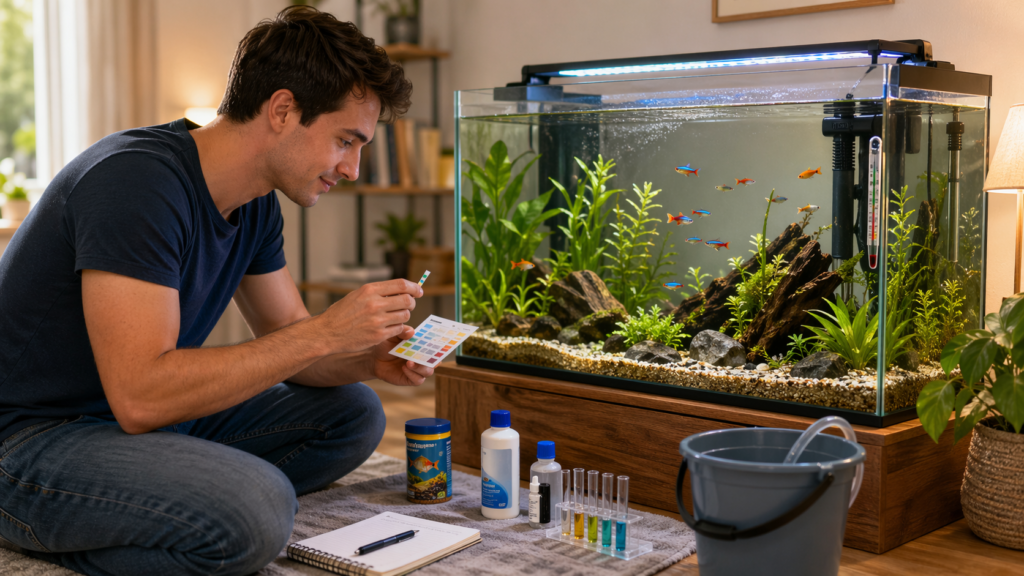
A basic aquarium test kit is not optional equipment. It is part of the life-support system.
New fish owners should be able to test for:
- Ammonia
- Nitrite
- Nitrate
- pH
- Temperature
- Chlorine or chloramine where relevant
Merck Veterinary Manual recommends increased monitoring when ammonia or nitrite are detectable, and daily monitoring during the startup phase of a new biological filter or recirculating system. (Merck Veterinary Manual)
If something seems off with your fish, test the water before adding treatments. Water quality is often the first place to look.
Mistake 4: Forgetting to Treat Tap Water
Tap water may be safe for people, but that does not automatically make it safe for fish.
Many municipal water systems use chlorine or chloramine. These chemicals are there for human water safety, but they can be toxic to fish and to the beneficial bacteria in an aquarium. Merck Veterinary Manual notes that most city water is treated with chlorine or chloramine, and both are toxic to fish and to the necessary bacteria that grow in the aquarium. (Merck Veterinary Manual)
Use a proper aquarium water conditioner whenever adding tap water unless you know your water source and treatment requirements. Follow the product directions.
Do not guess. Do not assume “it looks fine.” Water treatment is cheap compared with replacing fish and rebuilding a crashed tank.
Mistake 5: Adding Too Many Fish Too Fast
A new aquarium can only handle so much biological load at once.
Every fish produces waste. More fish means more ammonia. If the beneficial bacteria in the filter are not ready for that load, water quality can crash.
Add fish slowly. Let the filter and bacteria adjust. Test the water after additions. Watch the fish closely.
This is especially important with community tanks. New owners often want a lively, colourful tank right away, but stocking too quickly is one of the fastest ways to create stress, disease, and water quality problems.
A good aquarium is built in stages.
Mistake 6: Choosing Incompatible Fish
Not every fish that looks nice together should live together.
Fish differ by:
- Temperature range
- pH and hardness preference
- Adult size
- Activity level
- Aggression level
- Schooling needs
- Fin-nipping behaviour
- Feeding style
- Territory requirements
- Waste production
A peaceful community fish, a fin-nipper, a predator, and a delicate slow-feeder may all be sold in the same store, but that does not mean they belong in the same tank.
Before buying any fish, check the adult size, temperament, preferred water conditions, and group size. Schooling fish should usually be kept with others of their own kind. Territorial fish need space. Some fish are peaceful when young and difficult when mature.
Impulse purchases are where many community tank problems begin.
Mistake 7: Overfeeding
Fish are very good at looking hungry.
That does not mean they need more food.
Overfeeding is one of the easiest ways to damage water quality. Uneaten food breaks down in the tank and adds to the waste load. More waste means more ammonia pressure, more nitrate buildup, more algae, and more stress on the system.
Feed lightly. Watch what the fish actually consume. Remove uneaten food where practical. Adjust feeding based on species, age, temperature, and tank conditions.
A fish should be well-fed, not constantly fed.
Mistake 8: Cleaning Too Much at Once
This surprises new owners.
Yes, aquariums need cleaning. No, you should not sterilize everything.
The beneficial bacteria that support the aquarium live heavily in the filter media, substrate, and surfaces. If you replace all the filter media, scrub everything aggressively, rinse biological media under untreated tap water, and do a massive water change all at once, you can disrupt the system that keeps the tank stable.
Better practice:
- Do regular partial water changes.
- Clean gently and consistently.
- Rinse filter media in removed tank water, not untreated chlorinated tap water.
- Avoid replacing all biological media at once.
- Leave some established surfaces undisturbed.
Routine partial water changes help control nitrate, and RSPCA Australia notes that partial water changes of about 10 percent per week can help keep nitrate levels within a safe range. (RSPCA Knowledgebase)
Mistake 9: Skipping Quarantine
New fish can bring in parasites, bacterial infections, fungal issues, or stress-related illness.
A quarantine tank gives new arrivals time to settle, recover from transport stress, and be observed before joining the main aquarium. Merck Veterinary Manual explains that quarantine helps prevent the accidental introduction or spread of infectious disease in an established fish population. (MSD Veterinary Manual)
For a brand-new owner with a first tank, quarantine may not always be practical at the start. But once there is an established aquarium, adding new fish directly to the main tank carries risk.
At minimum:
- Buy from clean, reputable sources.
- Avoid tanks with dead, sick, gasping, clamped, or flashing fish.
- Do not pour store water into your aquarium.
- Observe new fish carefully.
- Consider a quarantine setup before adding more stock.
Mistake 10: Treating the Tank Before Knowing the Problem
When fish look unwell, it is tempting to start adding medications right away.
Sometimes medication is needed. Sometimes the real problem is water quality, temperature, bullying, poor oxygenation, stress, or a new-tank issue. Treating without diagnosis can make things worse, especially if the treatment affects the filter bacteria or stresses already weakened fish.
First steps when fish look wrong:
- Test ammonia, nitrite, nitrate, pH, and temperature.
- Check the heater and filter.
- Look for aggression or bullying.
- Review recent changes.
- Check whether new fish were added.
- Look for visible signs such as spots, fungus, swelling, damaged fins, gasping, or abnormal swimming.
If the fish are valuable, symptoms are severe, or losses are occurring, contact a veterinarian with aquatic animal experience.
Mistake 11: Ignoring Temperature
Fish are not all the same.
Goldfish, bettas, tropical community fish, cichlids, marine fish, and pond fish can have very different environmental requirements. A heater may be essential for one species and inappropriate for another.
Temperature affects metabolism, oxygen demand, appetite, digestion, immune function, and stress level. A tank that is too cold, too hot, or swinging up and down through the day can cause problems even when the water looks clean.
Use a thermometer. Do not rely only on the heater setting. Confirm the actual water temperature.
Mistake 12: Forgetting That Fish Need Enrichment Too
Fish need more than water and food.
A good aquarium should give fish appropriate places to swim, hide, rest, explore, and establish territory. The right setup depends on the species. Some fish need plants. Some need caves. Some need open space. Some need sand. Some need wood, rockwork, current, shade, or floating cover.
A bare tank may be easy to clean, but it may not provide enough security. A stressed fish may hide constantly, refuse food, become aggressive, lose colour, clamp fins, or become more vulnerable to illness.
Good aquariums are designed around the fish, not just around the decoration theme.
The Main Rule: Slow Down
Most aquarium problems come from rushing.
Rushing the setup.
Rushing the cycle.
Rushing stocking.
Rushing compatibility decisions.
Rushing treatment.
Rushing cleaning.
Fish keeping rewards patience. A stable tank built slowly will usually be healthier, easier to maintain, and more enjoyable than one filled in a weekend.
Before bringing fish home, know the basics:
- What species are you keeping?
- How large will they get?
- What tank size do they need?
- What temperature do they need?
- Are they social, territorial, aggressive, or shy?
- What do they eat?
- Are they compatible with the fish you already have?
- Is the tank cycled?
- Do you have test kits?
- Do you have water conditioner?
- Do you have a maintenance plan?
Final Thought
New fish owners do not need to know everything on day one. They do need to know that an aquarium is a living system.
Fish care is not about filling a tank and hoping for the best. It is about building stable water, choosing the right fish, adding them slowly, and paying attention when something changes.
Take your time. Ask questions. Test the water. Research before buying. Your fish will do better, and your aquarium will be much easier to enjoy.
Suggested reference sources: RSPCA fish care guidance, RSPCA Australia aquarium water quality guidance, Merck Veterinary Manual aquatic systems and aquarium fish guidance, and University of Florida IFAS aquatic animal health resources.
Just keep swimming
-Dory